I have never seen anything so beautiful. The country around the river is full of trees, beautiful and green and different from ours, each with flowers and its own kind of fruit. There are many birds of all sizes that sing very sweetly, and there are many palms…
log of Christopher Columbus
for Sunday, 28 October 1492, in Cuba.
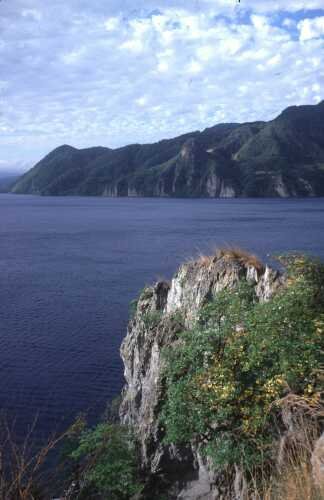
The term tropical rain forest was coined by the German explorer Andreas Schimper in his classic text (1898) Plant Geography. He gave this definition for rainforest – “Evergreen, hygrophilous in character, at least 30 m high, but usually much taller, rich in thick-stemmed lianes and in woody as well as herbaceous epiphytes”. Others have noted the species richness of the rainforest community.
Rainforest, as the name suggests, relies on an abundance of water such that it is largely limited to the humid tropics, i.e. equatorial regions. In the Caribbean, the seasonal climate precludes rainforest in the lowlands but at modest elevations on the mountainous islands there is adequate rainfall yearound to allow such a plant community to develop. Not surprisingly this rainforest type is distinct from that found on the South American continent.
Rainforest
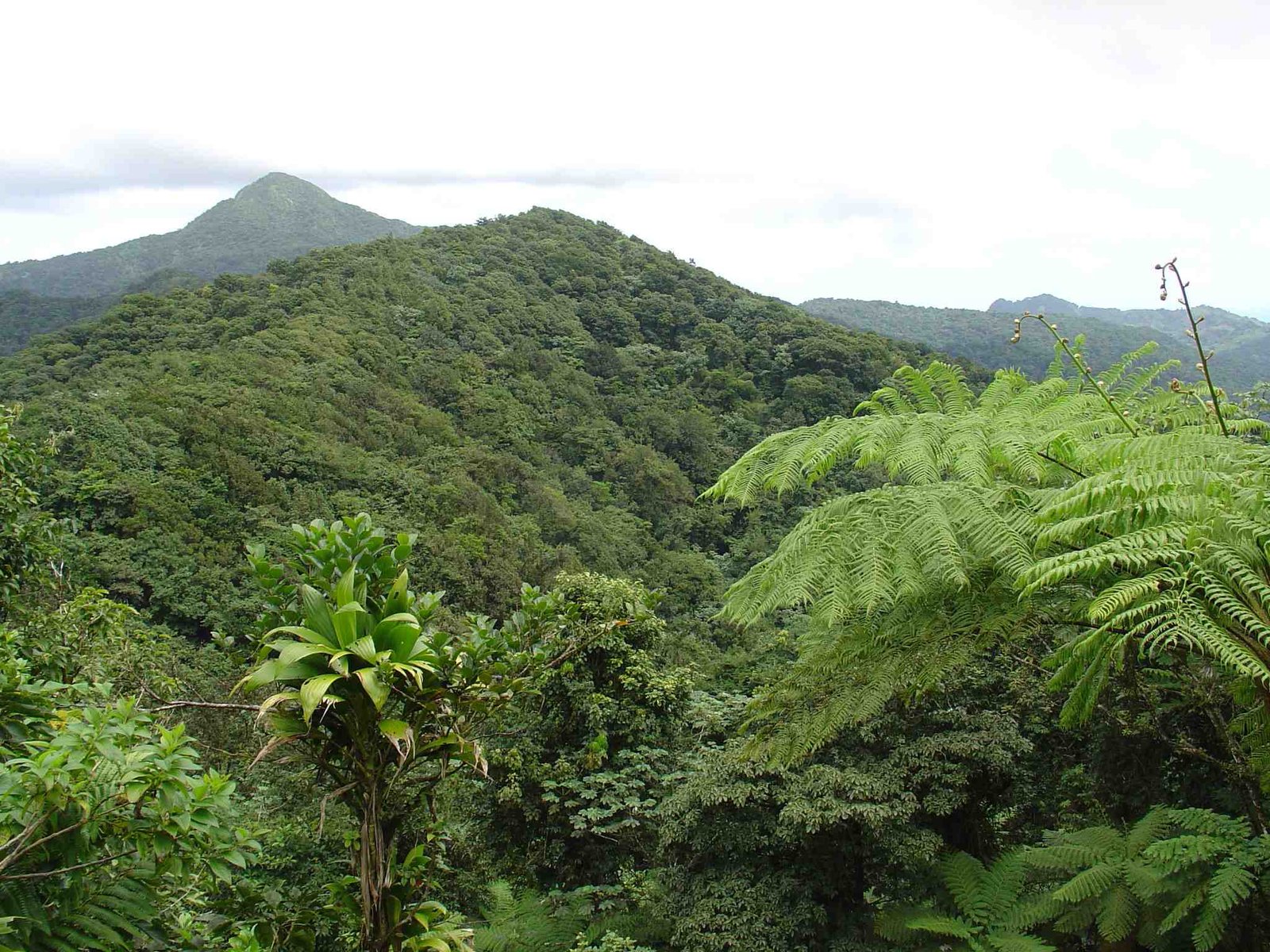
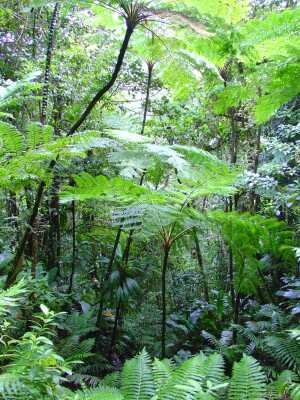
The rainforest of the Caribbean islands is known as the Dacryodes-Sloanea association after the two dominant trees of the principal canopy. It is also known as submontane rainforest. This 3-tiered forest comprises an upper closed canopy 30 m high, a discontinuous middle tree layer at 20 m and a low storey of small trees at 10 m. Gommier (Dacryodes excelsa) is the dominant tree and is joined in the uppermost layer by, among others, several species of chataignier ( Sloanea spp.) with their large plank buttress roots. Bois côte (Tapura antillana) is the commonest tree of the middle layer while the swizzle stick tree (Quararibea turbinata) is a common understorey species. Members of the coffee family are common in the shrub layer but also present may be tree ferns as well as palms such as the macaw palm (Aiphanes minima). On the branches and trunks of the lowest trees are found epiphytic ferns, bromeliads and aroids like the bird nest anthurium (Anthurium hookeri). There may be a sparse herb layer with the fern ally Selaginella flabellata, native to the Lesser Antilles and northern South America. There are woody vines or lianas which are rooted in the ground and climb and spread in the canopies. The rainforest trees tend to have largish leaves and are without spines. The undergrowth of shrubs, herbs and saplings is usually easy to penetrate.
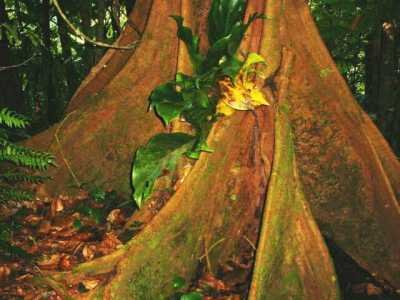
Photo © Sean Carrington.
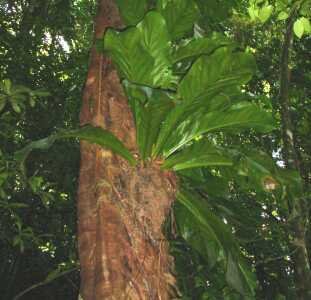
epiphytically. (Photo © Sean Carrington.)
The forester John Beard in his classic (1949) Natural Vegetation of the Windward & Leeward Islands pointed out that some 40% of rainforest tree species are endemic to the Lesser Antilles and many of the others are natives with a wider distribution (e.g. endemic to the Lesser Antilles and northern South America). Our improved knowledge of regional flora would suggest a lower figure of 30% for rainforest trees that are strict Lesser Antillean endemics. Few if any introduced species have become naturalized in this plant community. Not surprisingly, these Lesser Antillean endemics are especially centred on the four older islands of the archipelago, Guadeloupe, Dominica, Martinique and St Lucia. In the Eastern Caribbean, rainforest is limited to the high volcanic islands.
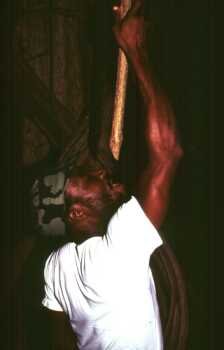
liana called liane chasseur (Pinzona coriacea) in St Lucia.
(Photo © Sean Carrington.)
The two dominant trees…
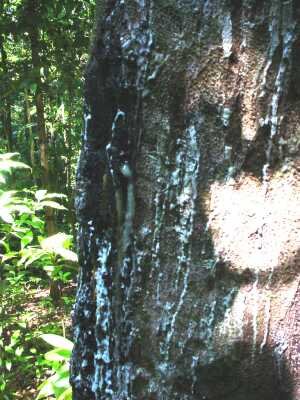
which is used as incense in Dominica. (Photo © Sean Carrington.)
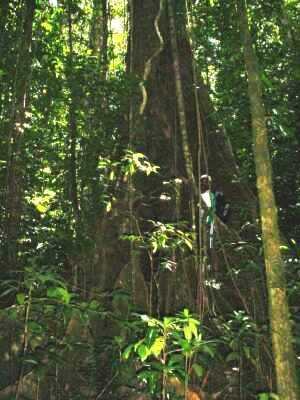
(Photo © Sean Carrington.)
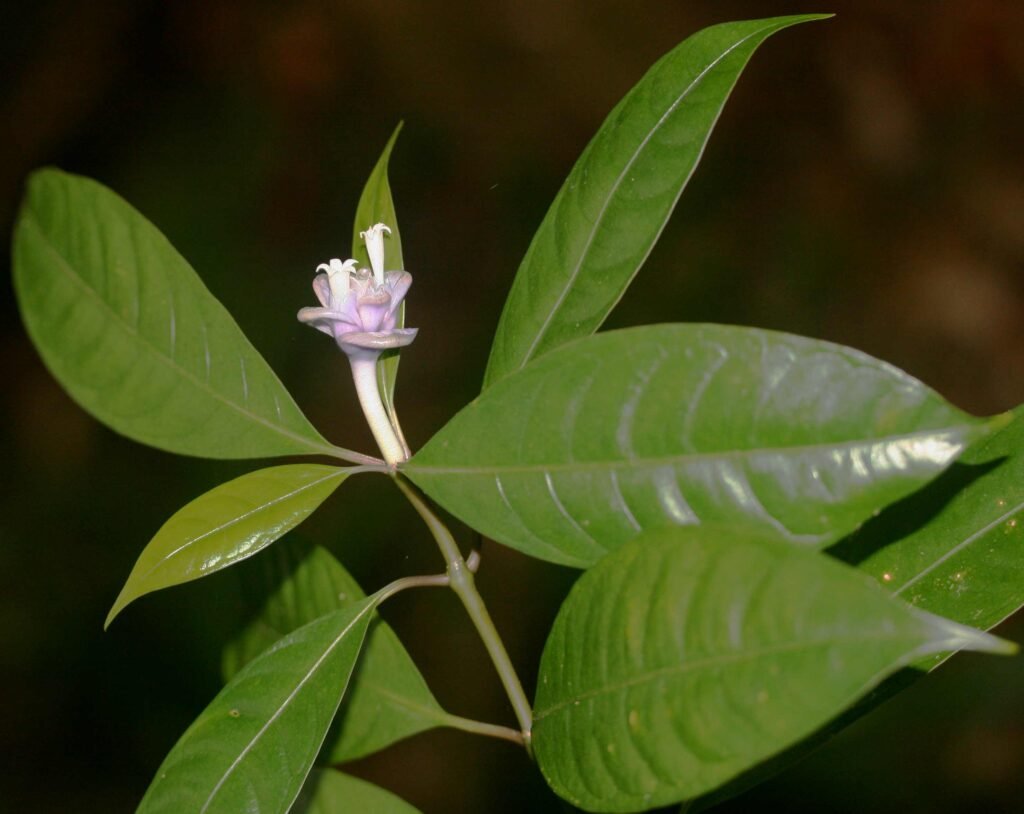
(Photo © Sean Carrington.)
Environmental factors
This forest occurs in the wet zone (> 1800 mm / 70 ” rainfall annually) and, although there is still a period of reduced rainfall, there is always an excess of water supply over demand such that there is effectively no dry season. It lies typically at 300 -750 m and in Dominica may receive annual rainfall of 4000-7500 mm (170-300″)!
Animal life
A wide range of bird species, most notably single island endemic parrot species on several islands. Also agouti, opossum, boas and other snakes, bats and arthropods.
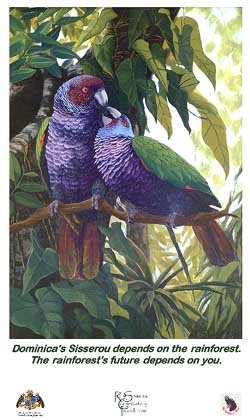
Which other Lesser Antillean islands have already lost their parrot species?
Caribbean Vegetation Mapping Project Equivalent
I.A.1.N.b. Submontane tropical or subtropical rain forest
I.A.1.N.b. Dacryodes excelsa – Sloanea massonii Forest Alliance (Dacryodes excelsa – Sloanea massonii submontane rain forests)